

Meeting/Event Information
March 2016 Dinner Meeting
March 10, 2016
5:30 PM - 8:30 PM
Add to Calendar
Four Points by Sheraton
1010 Northgate Drive
San Rafael, CA
Directions
Fred Bauman and Caroline Karmann presenting...
"Radiant slab systems research update: Effect of acoustical canopies on chilled ceiling performance"
| Agenda | 5:30pm | Registration and Social Hour | ||
| 6:30pm | Dinner, Announcements and Introductions | |||
| 7:30pm | Main Program | |||
| 8:30pm | Adjourn |
| Speaker(s) |
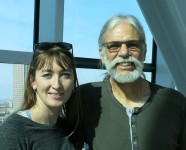
Fred Bauman & Caroline Karmann from the Center for the Built Environment Fred Bauman, P.E., is a Project Scientist at the Center for the Built Environment at UC Berkeley. His research interests include radiant and hydronic-based cooling, underfloor air distribution (UFAD), displacement ventilation (DV), personal comfort systems (PCS), room air distribution, thermal comfort, building energy use, ventilation and indoor air quality, laboratory and field measurement methods, and natural ventilation. Fred led the development of CBE’s world renowned UFAD research program and was the author of the first Underfloor Air Distribution (UFAD) Design Guide, published by ASHRAE in 2003. He is currently leading CBE’s research program on advanced integrated systems with a focus on radiant slab cooling (Thermally Activated Building Systems, TABS). Caroline Karmann is a PhD candidate in the Building Science program at the University of California, Berkeley, and also works as a graduate student researcher at the Center for the Built Environment. She received a Masters in Architecture (2006) and Climate and Energy (2008) from INSA Strasbourg, France. After graduation, she worked at Transsolar Energietechnik in Stuttgart, Germany for 4 years and specialized in daylight simulation and energy analysis. At UC Berkeley, her doctoral research has been focused on indoor environmental quality for buildings using radiant systems. Her work includes thermal comfort, acoustical quality and occupant satisfaction for buildings with radiant systems.
|
|
| Presentation Summary |
Radiant slab systems, often referred to as thermally activated building systems (TABS), have the potential to achieve significant energy savings, peak demand reduction, load shifting, and thermal comfort improvements compared to conventional all-air systems. As a result, application of these systems has increased in recent years, particularly in zero-net-energy (ZNE) and other advanced high performance buildings. Exposed concrete ceilings, while providing the best configuration for radiant cooling in open plan offices and other buildings, create acoustical challenges due to the high reflectivity of the concrete. This presentation will provide an overview of ongoing research on radiant systems at the Center for the Built Environment (CBE) at UC Berkeley and will highlight the results of a recent full-scale laboratory study to investigate an integrated ceiling design solution that can both improve the acoustical quality of the space while also enhancing the cooling performance of a chilled radiant ceiling system. Fred will introduce CBE’s multi-year $3M research project on radiant slab systems funded by California’s Electric Program Investment Charge (EPIC) Grant Program. Caroline will describe the results of two laboratory experiments that addressed cooling and acoustical performance. The radiant cooling capacity testing was conducted in the Hydronic Test Chamber at Price Industries in Winnipeg, MB, and the acoustical testing was completed by Armstrong World Industries in their reverberant chamber in Lancaster, PA. In the test configuration, free-hanging acoustical canopies were suspended below a radiant chilled ceiling to provide improved sound absorption. Fans (different configurations) were also installed at the ceiling level to increase the convective heat transfer along the chilled ceiling. The acoustical results showed that if the canopies covered 40-50% of the ceiling area, acceptable acoustic quality was achieved. The cooling experiments showed that the acoustical canopies caused a smaller reduction in cooling capacity than previously thought. The use of fans was able to offset the cooling reduction from the canopies and provide a higher overall cooling performance compared to an exposed radiant ceiling with no canopies and fans. |

Tickets
$40.00 Golden Gate Chapter member price
$50.00 after 05:00 pm March 4
$40.00 Redwood Empire Section member price
$50.00 after 05:00 pm March 4
$50.00 Non-member price
$55.00 after 5:00 pm March 4
$0.00 Students
$320.00 Chapter meeting voucher
